
DHL Group CEO Tobias Meyer warned Bloomberg TV earlier this morning that a persistent Gulf energy shock could morph into broader trouble for the global economy.
“Well we have seen this before, that you have recognized by consumers as having an impact that sparks broader discussion, the real economic implications for people. Now, this hasn’t happened yet. We’re trying to prevent that from happening. The 10, 12 million barrels of crude oil per day, it will come to that tipping point. Solutions are needed and political momentum is building up to resolve the situation in the Strait of Hormuz,” Meyer said.
Meyer’s reference to the “tipping point” is clear: if Gulf oil losses of 10 to 12 million barrels per day are not offset soon, global energy and product prices will stay elevated, causing significant knock-on effects throughout the world economy.
DHL Group sits at the center of global trade. It operates parcel, express, air freight, ocean freight, and road freight, as well as supply chain services, across more than 220 countries and territories, suggesting that Meyer is a seasoned observer of what to look for ahead of inflection points in the global economy.
Meyer pointed out that the US-Iran conflict and the disruption of the Hormuz chokepoint are already affecting DHL operations, constraining transport routes, tightening freight markets, and pushing shipping rates higher, especially on Asia-Europe lanes.
He added that, with Western airlines avoiding Russian airspace and Gulf carriers operating below pre-war capacity, trade flows from India and Southeast Asia to Europe are becoming more strained.
Meyer is clear that failing to replace the loss of 10 million to 12 million barrels of crude oil per day in the Gulf would almost certainly push the global economy to a “tipping point” from which there is no return.
Separately, the International Energy Agency released a report early last week that stated, “The Iran war has thoroughly upended the global outlook for oil consumption. Demand destruction will spread as scarcity and higher prices persist.”
JPMorgan’s top commodity expert recently described how the demand destruction crisis would spread from the Gulf area, hitting Asia first, then Africa and Europe, before ultimately affecting the US, especially California.
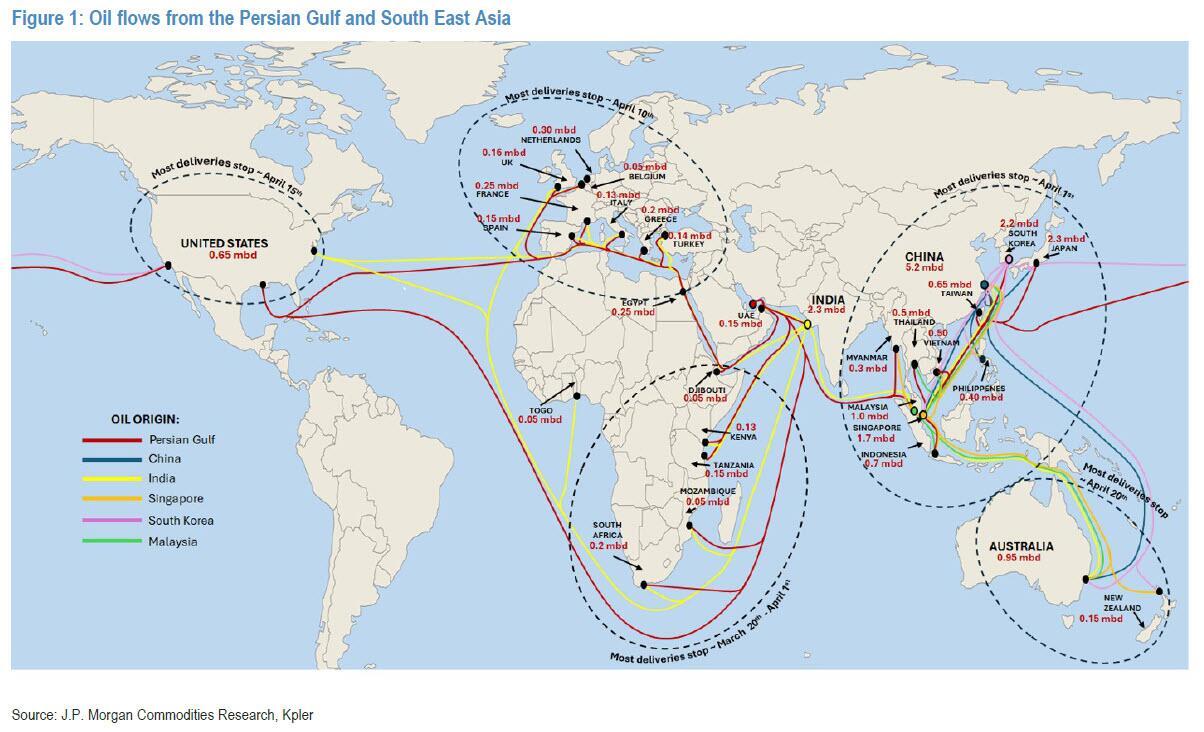
With the Strait of Hormuz still effectively shut by Iran, a U.S. naval blockade in place, and U.S.-Iran talks potentially set for later today ahead of Wednesday’s ceasefire deadline, even an immediate diplomatic breakthrough would not restore energy flows overnight. Gulf-area export hubs would still take months to return to normal.
This shows that the Gulf energy shock threatens to push the global economy dangerously close to the tipping point Meyer describes.