
By Murtaza Hussain – Drop Site News

On May 12, U.S. Ambassador to Israel Mike Huckabee publicly disclosed a significant development in the military relationship between Israel and the United Arab Emirates amid the war in Iran.
“Israel just sent [the UAE] Iron Dome batteries and personnel to help operate them,” Huckabee said at an event in Tel Aviv. Huckabee described the deployment as a fruit of the Abraham Accords, calling the Israeli-Emirati relationship “extraordinary.”
The deployment—as Iranian missiles and drones targeted the region in response to a joint U.S.-Israeli attack—marked the first publicly acknowledged presence of Israeli military personnel and air-defense equipment inside a Gulf monarchy. But the integration of Israeli weapons into the UAE’s defenses did not begin with the Iran war.
An archive drawn from the email account of Vered Haimovich, a former Israeli military officer who became vice president of Elbit Systems’ UAV Systems Business Unit in January 2021, shows how the arms company worked in the aftermath of the Abraham Accords to create a channel for the sale of drones and aerial surveillance equipment to Abu Dhabi.
The email archive includes internal documents from Elbit and its Emirati subsidiary, as well as documents identified as request lists from the UAE military to Elbit in the context of negotiating weapons deals. Drop Site conducted cryptographic verification on the email address signatures and also verified non-public contact information for parties referenced in the documents.
The email archive was published by Distributed Denial of Secrets and released by Handala, an online hacking group presumed to be tied to the Iranian Ministry of Intelligence. The archive consists of personal messages, newsletters, and advertisements from Haimovich’s Gmail account. But it also contains a smaller collection of Elbit correspondence that executives from the company sent to her personal account—along with Elbit documents Haimovich forwarded to her own Gmail account from her Elbit address.
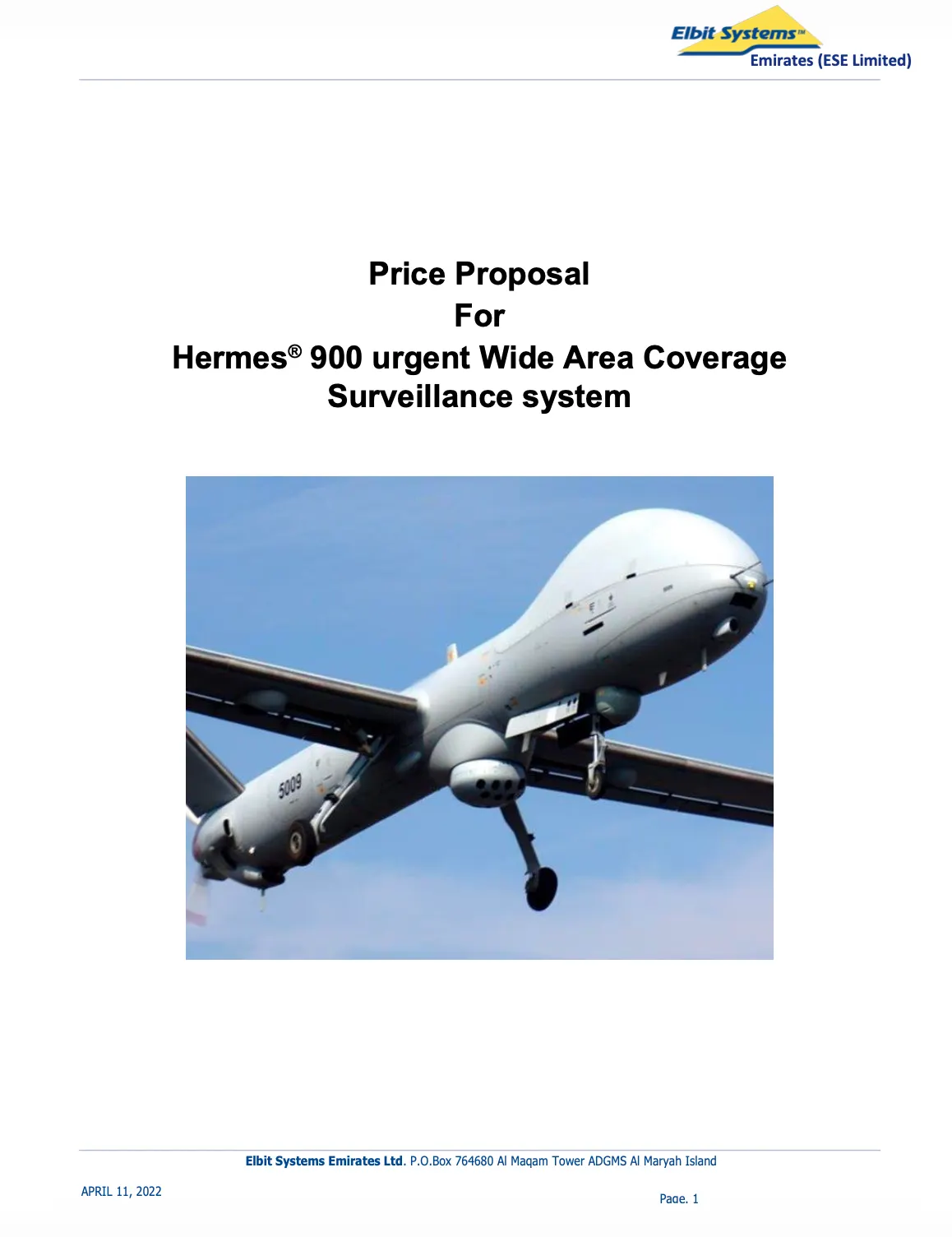
The Elbit emails, dating from late 2021 through early 2023, include a detailed April 2022 proposal from Elbit Systems Emirates subsidiary to provide a suite of Hermes 900 drones with supporting equipment and logistical support to Abu Dhabi. The proposal lays out the terms of a deal that would see the Israeli defense manufacturer provide the UAE two Hermes 900 systems comprising six aircraft, SkEye wide-area surveillance sensors, ground-control equipment, training, and logistical support.
The proposal identifies Elbit Systems Ltd. as the seller and says the package was intended to meet an “Urgent Operational Requirement” of the UAE. The initial package offered six aircraft and supporting systems for $154 million with additional upgrades that would raise its total value to approximately $225 million.
Other documents also point to a broader Emirati interest in airborne intelligence and electronic-warfare capabilities provided by Israeli firms. One photographed document, labeled “Confidential” and titled “Airborne SIGINT Wish List,” describes itself as a UAE Armed Forces request for two manned and two unmanned signals-intelligence aircraft. The request sought systems capable of intercepting cellular and satellite communications and conducting electronic attacks involving cyber operations, lasers, and high-power microwave technology.
Neither Elbit nor the Emirati government has publicly confirmed that the UAE has acquired or currently operates Hermes drones, and the documents available in the archive do not include a final purchase order or delivery record, although internal correspondence repeatedly described the Emirati requirements at the time as urgent and stated that an agreement could close within weeks.
Despite public proclamations of the close relationship between the two countries by both Emirati and Israeli officials, specific details of their defense relationship have remained largely hidden from the public.
In 2025, it was reported that the UAE’s Edge Group was in talks with Elbit to purchase the Hermes 900 in a deal that would include “transfer of technology and localized production,” from Tel Aviv to Abu Dhabi, marking a rare public acknowledgement of an opaque defense relationship that has slowly been coming out of the shadows since the signing of the Abraham Accords in 2020.
Reached for comment, Elbit Systems stated that it “does not comment on business matters relating to its customers,” but added, “the materials presented do not accurately reflect the company’s business activities.” The company did not respond to follow-up questions.
The Emirati embassy and Ministry of Defense did not respond to a request for comment.
“We need to move quickly”
On November 14, 2021, Elbit publicly announced that it had established Elbit Systems Emirates as a subsidiary that would pursue “long-term cooperation” with the UAE Armed Forces, customize systems for Emirati requirements, and lead technology transfers to the country.
At the time, both countries were still basking in the glow of the recently signed Abraham Accords, which had helped set the stage for a more overt partnership.
“The Abraham Accords provide a sound basis for business collaborations in the region,” Elbit executive Ran Kril said in the company’s announcement. Five days earlier, internal correspondence from Haimovich’s inbox indicated that Elbit had already received preliminary policy authorization to pursue a Hermes 900 sale to the UAE in a restricted configuration.
A November 9 email, written by Elbit executive Michael Edelstein, summarized a meeting the previous day between Elbit CEO Bezhalel Machlis and the head of the Israeli Defense Ministry’s Defense Export Controls Agency. Under the heading “United Arab Emirates,” Edelstein wrote that the official had given permission to proceed with a “900” drone in an imaging-only configuration. The UAE was also described as an important prospective customer for Israeli arms, though development of the relationship would depend on political conditions. “The potential is considerable, but for internal and external strategic reasons, progress will not be comprehensive immediately,” Edelstein wrote.
The email also mentioned a list of candidates for weapons exports to other Gulf Arab states, including Saudi Arabia, for whom a C-130 aircraft upgrade is noted in the email as “approved to proceed,” along with artillery equipment for the Saudi military.
The Israeli Defense Export Controls Agency, the email continued, had approved the sales to Riyadh so long as the artillery equipment did not match planned IDF military upgrades, and despite concerns that “development of relations is progressing slowly” with Saudi Arabia, which is not a signatory to the Abraham Accords and does not maintain official relations with Israel.
Qatar is also listed in the email as approved for the sale of an aircraft protection countermeasure system known as DIRCM, as well as additional signals intelligence equipment to Bahrain.
The Qatari, Saudi, and Bahraini embassies did not respond to requests for comment.
The same email also addresses the possibility of receiving future export authorization for the sale of offensive weapons for the UAE. The first was Elbit’s MPR 2000, a 2,000-pound air-dropped penetrator bomb designed to break through reinforced concrete before exploding. The second was the SkyStriker—known in Hebrew as “Shrakek”—an Elbit loitering munition, or explosive attack drone, designed to circle over an area before diving into a target.
“Pay attention to the 900,” Elbit executive Yoram Shmuely wrote when forwarding the summary to Haimovich. “We need to move quickly.”
The drone effort formed part of a broader opening that was rapidly producing publicly announced defense partnerships between Abu Dhabi and Tel Aviv. Four days after Elbit announced its Emirati subsidiary, the UAE’s EDGE Group and Israel Aerospace Industries signed a memorandum of understanding to jointly design a series of 17-meter unmanned surface vessels. The proposed vessels would support intelligence, surveillance, and reconnaissance; border patrol; mine detection and sweeping; submarine detection and anti-submarine warfare; and maritime-security operations, according to the companies’ announcement.
On January 3, 2022, Elbit announced its first publicly disclosed contract through the Emirati subsidiary: a five-year, approximately $53 million agreement to supply directed infrared countermeasures and electronic-warfare self-protection systems for the UAE Air Force’s Airbus A330 tanker transport aircraft.
But that public contract was narrower than the drone and intelligence package Elbit was developing privately.
The UAE’s security situation changed dramatically later that month. On January 17, Yemen’s Ansarallah movement claimed a missile-and-drone attack on Abu Dhabi. Explosions engulfed three fuel tankers near an Abu Dhabi National Oil Company storage facility, killing three people and wounding six; a separate fire broke out at an extension of Abu Dhabi International Airport. A week later, the UAE said its defenses had intercepted and destroyed two Houthi ballistic missiles targeting Abu Dhabi.
By March, internal correspondence described the Emirati project as urgent, and an Elbit planning memorandum said the system was intended to detect missile and drone launches from beyond the UAE’s borders.
“They want the SkEye with the 900,” Hagi Topolansky, then an Elbit senior vice president responsible for UAVs and strategic affairs and a former deputy commander of the Israeli Air Force, wrote in a March 8 email. The passage appeared under “Arig,” a designation that other documents connect to the UAE. Topolansky relayed an unnamed official’s assessment that the transaction would close “within a few weeks,” adding that the official was highly optimistic and that the customer was “under pressure.”
In a separate line, Topolansky wrote that an unidentified customer “really wants” a laser system and that discussions were progressing well. The email did not identify the customer, the laser product, or its price.
On March 13, emails show that Elbit executive Amir Bettesh circulated a planning memorandum to push forward a deal. The memorandum described an initial proposal for five complete Hermes 900 systems for the UAE—three aircraft per system, or 15 aircraft in total. Each system would include electro-optical sensors with laser target designators, daytime and nighttime SkEye systems, self-protection and electronic-warfare equipment, along with ground equipment and training, noting that a “significant discount” had been applied to the proposed sale at customer request.
According to the memorandum, the systems were intended to maintain surveillance beyond the customer’s borders and detect missile and drone launches into the country, but could also be used domestically for “homeland security” missions. The deal was portrayed in the document as queuing up a much larger line of business, stating that “in the next phase the customer intends to procure 15 systems in total—an additional 10 systems beyond the urgent operational requirement (UOR) described above—which will incorporate a broader range of mission payloads.”
The memorandum stated that the technical specifications, statement of work, financial offer, draft contract, and executive summary had already been delivered to the customer and were “ready for signature.”
Wish List
While the documents in Haimovich’s correspondence show that Elbit was pursuing a substantial Hermes 900 sale to the UAE in 2022 and record detailed Emirati operational requirements they do not confirm whether Abu Dhabi executed the sale at the time or received delivery of the systems.
Other correspondence contained in the archive indicate that talks were proceeding for the provision of Israeli-made UAVs and a much broader range of aerial surveillance and electronic warfare equipment to the Emirates.
On February 28, 2023, two short emails were sent from Haimovich’s personal Gmail account to her Elbit address. The subjects of the emails were listed as “Johan 1” and “Johan 2” and the underlying documents include metadata indicating that they were created in July 2022. The attachment in the email “Johan 1” is a photographed document marked confidential and titled “Airborne SIGINT Wish List.” The document describes itself as a UAE Armed Forces request to acquire two manned and two unmanned signals-intelligence aircraft. It asked that delivery of the initial aircraft, intelligence systems, and supporting equipment begin within 42 months of a contract’s initiation.
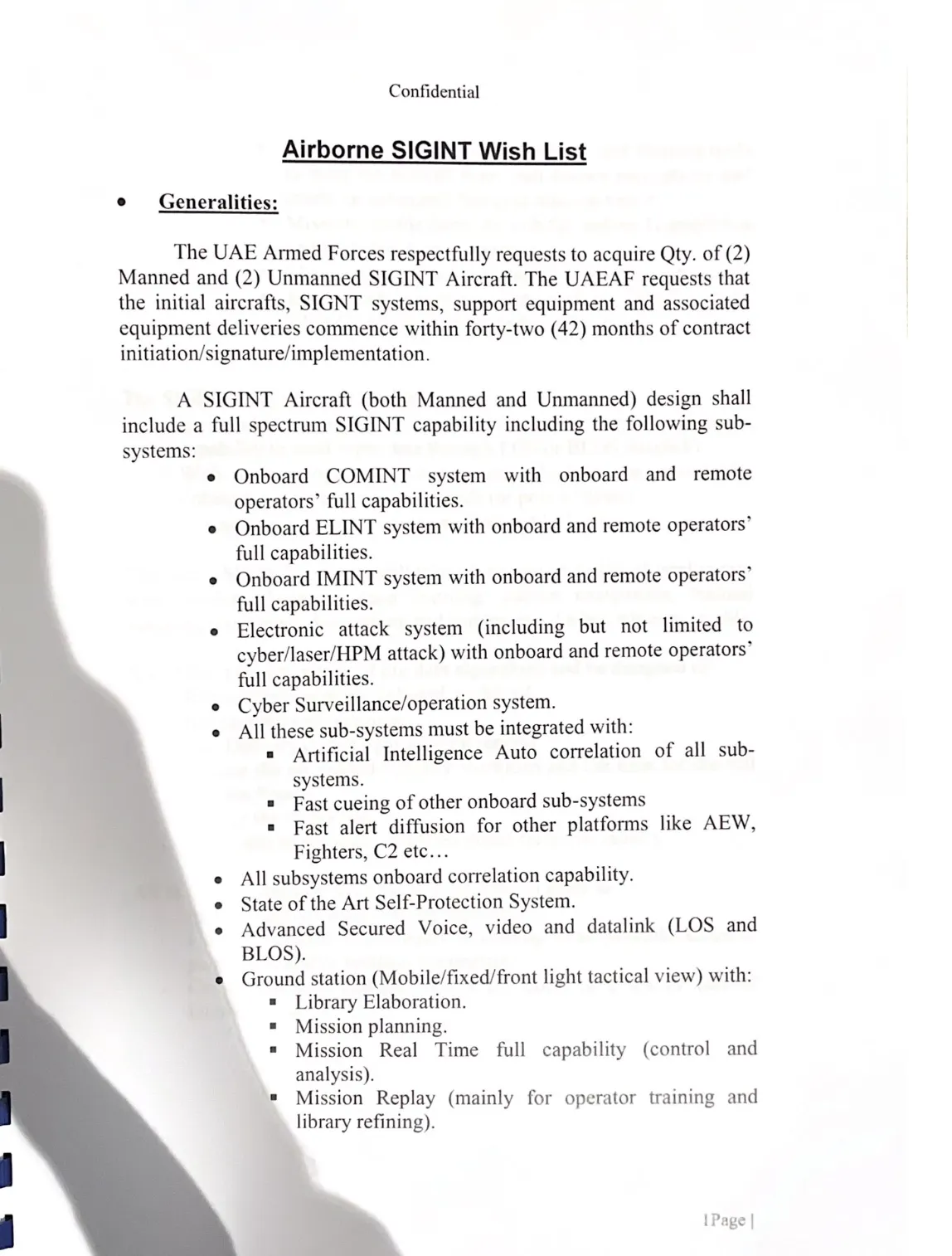
The requested aircraft referenced in the document would combine communications intelligence, electronic intelligence, imagery intelligence, electronic attack, cyber-surveillance, and artificial-intelligence capabilities. The electronic-attack requirement included “cyber/laser/HPM attack.” A separate technical document defines “HPM” as high-power microwave.
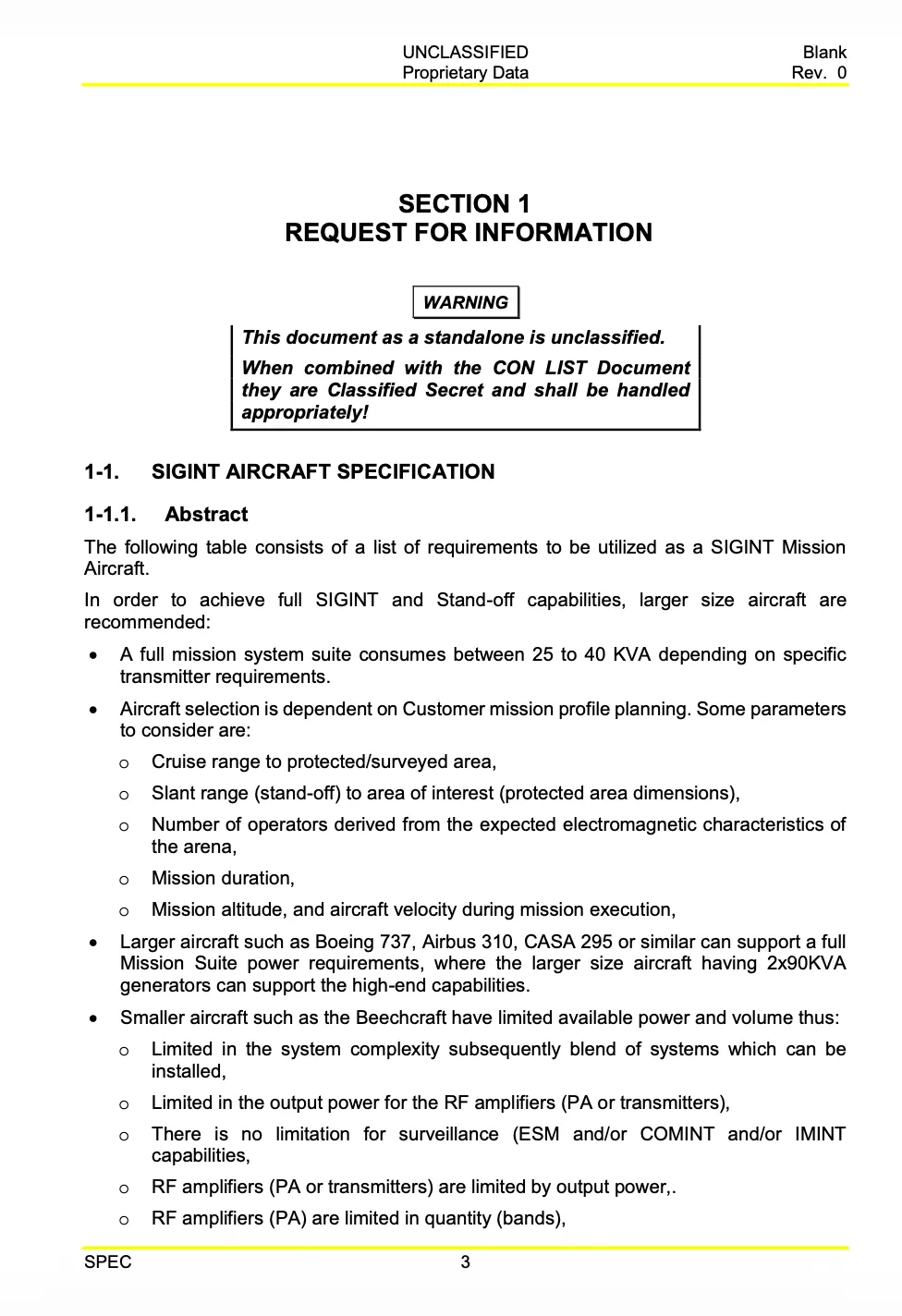
The document attached to “Johan 2” appears to be a detailed vendor response to the wish list in the first email. The document is marked as unclassified as standalone but classified secret when viewed in conjunction with other information and is labelled as “Commercial in Confidence”—a classification often used to refer to commercially sensitive material. The document proposes possible configurations for large and small manned aircraft and unmanned aircraft, as well as cellular and satellite-communications interception and electronic warfare capabilities.
The correspondence continues with emails—including “Johan 3” and “Johan 4”—containing password-protected draft files whose contents are not visible in the hacked email archive.
“More relevant and stronger”
The internal Elbit proposals and correspondence concerning the UAE and the sale of Hermes 900 systems and other aerial surveillance tools to Abu Dhabi emerged amid a rapidly expanding Israeli-Emirati military relationship that had evolved after the Abraham Accords from diplomatic normalization into increasingly open defense cooperation.
By September 2022, Reuters reported that Israel had agreed to sell the UAE a SPYDER air-defense system, citing sources familiar with the agreement. Neither government publicly confirmed the details at the time. In 2023, Israel’s Ministry of Defense inaugurated its first national pavilion at the IDEX arms exhibition in Abu Dhabi with more than 30 Israeli companies displaying air-defense systems, drones, artificial intelligence, electro-optics, and cyber technology.
In November 2025, Elbit announced an eight-year, $2.3 billion contract for an unnamed international customer. One month later, Calcalist reported, citing the French publication Intelligence Online, that the customer was the UAE.
The Iron Dome deployment during the 2026 Iran war represents yet another evolution in a relationship that has continued to blossom despite the genocide in Gaza and a regional war triggered by Israel and the U.S., bringing Israeli equipment and personnel to operate inside the Emirates during an active conflict.
Despite keeping many details of its defense cooperation with Israel secret, the UAE has become more vocal about its attachment to Tel Aviv, describing its relationship as one based on shared values and interests.
“Everything that the UAE does with Israel is formal, above board,” said Emirati presidential advisor Anwar Gargash in an interview this May. “We don’t have to find secret channels to do that, and I feel that that relationship is going to be even stronger, and the Israeli relationship is more relevant and stronger.”